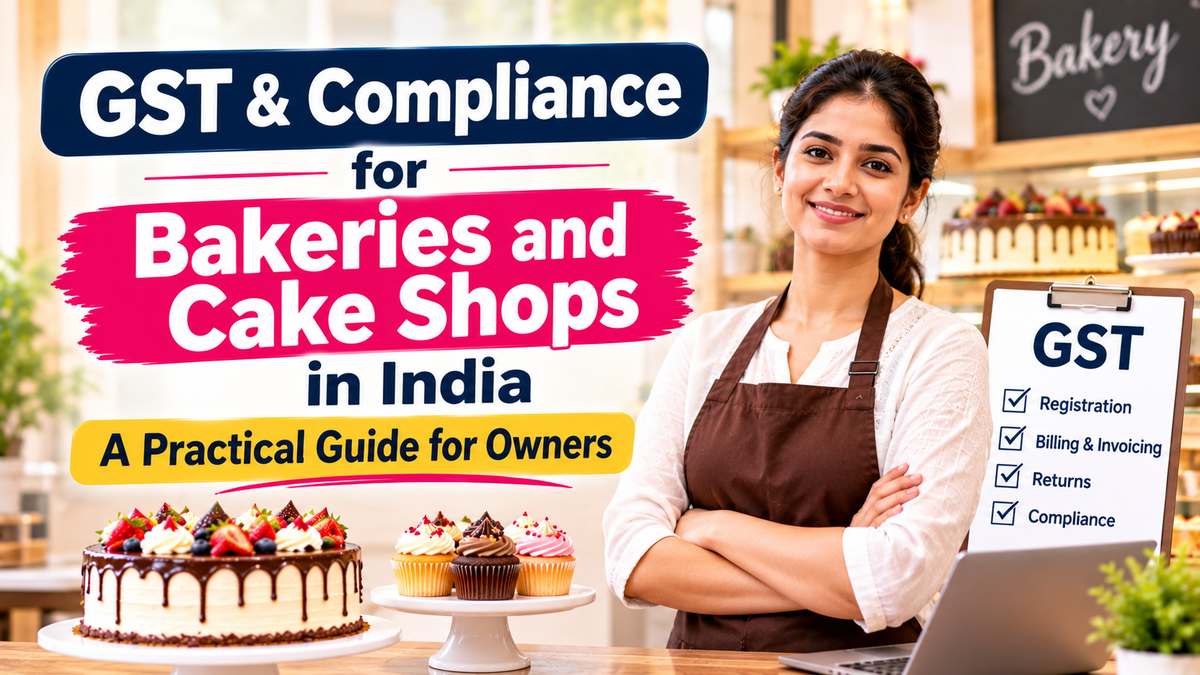
Running a bakery is about much more than preparing delicious cakes and serving customers. Behind every successful cake shop, there is also a business that needs to manage taxes, food safety, employee records, invoices, licences and other regulatory requirements.
For a small cake shop, these responsibilities may seem manageable. But as the business grows, opens additional outlets, starts supplying corporate customers or begins manufacturing packaged products, compliance becomes more complicated.
A missed GST return, an incorrect tax rate or an expired food licence can create unnecessary financial and operational problems.
Understanding the basic compliance requirements can help you avoid penalties, maintain customer trust and run your bakery with greater confidence.
Here is a practical guide to the important GST and compliance requirements that bakery and cake shop owners in India should understand.
1. Understand the GST Registration Requirements
One of the first questions for a bakery owner is whether the business needs GST registration.
In general, the GST registration threshold is:
₹20 lakh aggregate annual turnover for businesses supplying services in most states.
₹40 lakh for businesses exclusively supplying goods in states where the higher threshold applies, subject to applicable conditions.
However, certain activities and circumstances can make GST registration compulsory even below these thresholds.
For example, a bakery that supplies food as a restaurant service may have different registration considerations from a business that exclusively manufactures and sells goods.
Remember that aggregate turnover is calculated at the PAN level across India. It is not calculated separately for every shop.
What should a bakery owner do?
Monitor total turnover across all business activities and outlets. Do not wait until the end of the financial year to check whether registration is required.
Consult a GST professional to determine the applicable threshold based on your actual business model.
2. Know the GST Rates Applicable to Cakes and Bakery Products
Not every product sold by a bakery necessarily attracts the same GST rate.
The classification of the product, how it is supplied and the applicable GST notification determine the tax treatment.
Following the GST rate changes effective from 22 September 2025, the general GST rate for pastry, cakes and other bakery wares under HSN heading 1905 was reduced from 18% to 5%, subject to the applicable classification and exclusions.
However, a bakery may also sell products and provide services that fall under different classifications.
For example:
- Cakes and pastries
- Biscuits and cookies
- Bread and other bakery products
- Packaged desserts
- Beverages
- Dine-in food services
- Catering or event-related services
A bakery selling cakes over the counter and a bakery operating as a dine-in food establishment may need different GST classifications for certain supplies.
Do not assume that every item on your menu attracts the same GST rate.
Maintain a product-wise GST and HSN classification list and get it verified by your CA or GST consultant. Update your billing software whenever a rate or classification changes.
3. Generate Proper GST Invoices
Every GST-registered bakery should have a consistent billing process.
A tax invoice is not just a receipt. It is an important financial and tax document.
Depending on the transaction, a GST invoice generally includes:
- Business name, address and GSTIN
- Unique invoice number
- Invoice date
- Customer details, where required
- HSN or SAC code
- Product or service description
- Quantity and taxable value
- Applicable GST rate and tax amount
- Place of supply, where applicable
- Total invoice value
For regular retail customers, billing should be quick and accurate. For corporate customers, registered businesses and bulk orders, ensure that the required customer and GST details are captured correctly.
Also understand the difference between a tax invoice and a bill of supply. Businesses under the composition scheme and businesses making exempt supplies may need to issue a bill of supply instead of a regular tax invoice, as applicable.
Avoid handwritten adjustments, duplicate invoice numbers and informal sales records.
A reliable POS system can make it easier to generate invoices consistently and maintain transaction records.
4. File GST Returns and Pay Tax on Time
GST compliance does not end after generating invoices.
Registered businesses must file the applicable GST returns and pay their tax liabilities within the prescribed deadlines.
Common GST returns include:
GSTR-1: Contains details of outward supplies, subject to the applicable filing frequency and scheme.
GSTR-3B: A summary return used to report tax liabilities, eligible input tax credit and pay the applicable tax.
Businesses under the composition scheme follow a different return and payment process.
The filing frequency and applicable forms depend on the taxpayer's registration category and scheme.
Late filing can result in late fees, interest and other consequences.
A good practice is to maintain a monthly GST routine:
- Reconcile sales recorded in the POS with accounting records.
- Check credit notes, cancellations and refunds.
- Verify purchase invoices and eligible input tax credit.
- Reconcile relevant GST portal statements.
- Calculate the tax liability.
- File returns and pay tax within the prescribed deadlines.
- Do not wait until the last day to collect information from every outlet.
5. Understand GST Input Tax Credit
Input Tax Credit (ITC) allows eligible registered businesses to claim credit for GST paid on qualifying business purchases and expenses, subject to GST rules.
For a bakery, purchases may include:
- Ingredients and raw materials
- Packaging materials
- Equipment and machinery
- Store fixtures
- Certain professional services
- Eligible business-related expenses
However, not every GST payment automatically qualifies for ITC.
For example, restaurant services supplied by restaurants other than those covered under specified-premises provisions generally attract 5% GST without ITC.
The applicable ITC treatment also depends on the nature of the bakery's supplies and whether it makes taxable, exempt or other types of supplies.
Maintain proper purchase invoices and verify ITC eligibility before claiming it.
Your CA should review the applicable restrictions, documentation and reconciliation requirements.
6. Obtain the Appropriate FSSAI Registration or Licence
Food safety compliance is one of the most important responsibilities of a bakery.
Under the Food Safety and Standards Act, food businesses in India are required to obtain the applicable FSSAI registration or licence.
This applies to businesses involved in activities such as:
- Manufacturing cakes and bakery products
- Preparing and selling food
- Retailing bakery products
- Packaging and distributing food
- Operating a central kitchen
- Supplying food to other businesses
An important update came into effect on 1 April 2026.
FSSAI revised the turnover-based eligibility thresholds as follows:
Registration: Annual turnover up to ₹1.5 crore.
State Licence: Annual turnover above ₹1.5 crore and up to ₹50 crore.
Central Licence: Annual turnover above ₹50 crore.
The appropriate category also depends on the nature of the food business and applicable eligibility conditions.
FSSAI has also introduced perpetual validity for registrations and licences under the revised framework, subject to applicable regulatory conditions and compliance requirements.
Bakery owners should check their existing registration or licence status and confirm whether any modification is required.
Applications and modifications can be handled through the official FoSCoS portal.
7. Maintain Food Safety and Hygiene Standards
Having an FSSAI registration or licence does not mean that food safety responsibilities are complete.
Your bakery must follow applicable hygiene and food safety requirements.
Important areas include:
- Clean preparation and production areas
- Safe storage of ingredients
- Proper refrigeration and temperature control
- Pest control
- Safe drinking water
- Personal hygiene of food handlers
- Appropriate waste disposal
- Prevention of cross-contamination
- Safe handling and transportation of finished products
For example, cakes containing cream, dairy or other perishable ingredients need appropriate storage and handling.
Create simple daily cleaning and hygiene checklists. Train employees on food handling practices and maintain records of relevant cleaning, pest control and temperature checks.
For bakeries with central kitchens and multiple outlets, define food safety responsibilities at both levels.
8. Follow Food Labelling and Packaging Rules
If your bakery sells pre-packaged products such as cookies, brownies, packaged cakes or dessert boxes, labelling requirements become important.
Depending on the product and packaging category, applicable declarations may include:
- Name of the food
- Ingredient list
- Nutritional information
- Allergen declarations
- Vegetarian or non-vegetarian symbol, as applicable
- Net quantity
- Batch or lot identification
- Date marking and shelf-life information
- Storage instructions, where required
- Manufacturer or packer's details
- FSSAI logo and licence or registration number
- MRP and other applicable Legal Metrology declarations
The exact requirements depend on the product and applicable exemptions.
For example, a freshly prepared cake sold directly to a customer may not have exactly the same labelling requirements as a packaged product distributed through retail stores.
If you manufacture and package products for sale through other outlets, check the applicable FSSAI labelling and Legal Metrology requirements before printing packaging material.
Do not copy labels from another brand without verifying that they meet the requirements for your own products.
9. Understand Local Shop and Establishment Requirements
Opening a cake shop involves more than food-related permissions.
Depending on the state, city and nature of operations, you may need to comply with the applicable Shops and Establishments law and local municipal requirements.
These can cover:
- Shop registration or intimation
- Working hours
- Weekly holidays
- Employee records
- Leave and wage requirements
- Workplace conditions
- Display of prescribed notices
You may also need other local approvals depending on your premises and activities, such as municipal trade permissions, signage approvals or fire safety requirements.
A bakery with a production kitchen may have additional requirements compared with a small retail counter.
Check the rules applicable to the specific location before starting operations.
10. Maintain Employee and Payroll Compliance
As your bakery hires more employees, staff-related compliance becomes increasingly important.
Maintain proper records of:
- Employee names and contact details
- Joining dates and job roles
- Attendance
- Salary and wage payments
- Leave records
- Employment terms
- Statutory deductions, where applicable
Depending on employee strength, establishment type and applicable laws, your business may also need to comply with requirements relating to:
- Provident Fund (EPF)
- Employees' State Insurance (ESI)
- Professional Tax
- Minimum wages
- Payment of wages and other employment benefits
- POSH requirements relating to prevention of sexual harassment at the workplace
For example, the POSH Act requires an Internal Committee at workplaces with ten or more employees.
The applicability of EPF, ESI and other requirements depends on the relevant statutory thresholds and conditions.
Do not assume that a small bakery is automatically exempt from every employment-related requirement.
11. Keep Business and Accounting Records Organised
A bakery generates financial records every day.
Sales invoices, purchase bills, supplier payments, salary records, stock adjustments, refunds and expenses all need to be maintained properly.
Poor recordkeeping creates problems when preparing GST returns, reviewing profitability or responding to an audit or departmental query.
Maintain organised records of:
- Sales and purchase invoices
- GST returns and payment challans
- Bank statements
- Cash and UPI transactions
- Supplier details
- Employee payments
- Stock purchases and consumption
- Credit notes and refunds
- Expense records
- FSSAI and other licences
Keep digital backups and ensure that authorised people can access the information when required.
Your accounting records should also make it possible to understand the financial position of each outlet.
12. Understand Additional Compliance for Multi-Outlet Cake Chains
Compliance becomes more complicated when your bakery operates multiple outlets.
A business with five outlets cannot simply assume that one licence or registration automatically covers every location.
Consider these important points:
GST registration across outlets: Multiple locations within the same state may generally be declared as additional places of business under the relevant GST registration. Separate registrations are generally required in states from which the business makes taxable supplies, subject to applicable rules.
FSSAI permissions: Food business premises and activities must be covered by the appropriate FSSAI registration or licence. A central kitchen, manufacturing unit and retail outlets may require separate or appropriately linked permissions depending on their activities and eligibility.
Stock transfers: Transfers of goods between separately registered GST establishments of the same business can be treated as supplies between distinct persons, even when there is no consideration. Appropriate documentation and valuation rules may apply.
Outlet records: Maintain outlet-wise sales, purchases, expenses and inventory records. These help management reconcile financial information and support compliance.
Franchise operations: If franchisees operate under separate legal entities, their GST and FSSAI responsibilities may differ from those of company-owned outlets. Clearly define responsibilities in franchise agreements.
Before expanding into another state or launching a franchise model, review the compliance structure with a professional.
13. Check Whether E-Invoicing Applies to Your Bakery
Some growing bakery businesses may become subject to GST e-invoicing requirements.
As a general rule, e-invoicing applies to eligible registered taxpayers whose aggregate annual turnover exceeded ₹5 crore in any preceding financial year, subject to applicable exemptions and conditions.
For eligible transactions, invoices covered by the rules must be reported to an Invoice Registration Portal to obtain an Invoice Reference Number and other prescribed details.
This is particularly relevant for bakery chains supplying corporate customers, distributors or other registered businesses.
Check your turnover history and applicable transaction categories with your GST consultant.
Do not assume that e-invoicing is compulsory for every small bakery simply because it has GST registration.
14. Create a Compliance Calendar for Your Bakery
One of the easiest ways to avoid missed deadlines is to maintain a compliance calendar.
Instead of remembering every filing and payment date, assign responsibility and track the status of each requirement.
Your calendar may include:
Regular activities
- GST return preparation and filing
- GST payment and reconciliation
- Payroll and statutory payments
- Purchase and sales record updates
- Food safety and hygiene checks
Periodic activities
- FSSAI compliance checks
- Employee record reviews
- Accounting and financial reviews
- Licence and registration status checks
- Fire safety and equipment checks, where applicable
Whenever the business changes
- Opening a new outlet
- Starting a manufacturing unit
- Changing the legal entity
- Adding a new business activity
- Expanding into another state
- Introducing packaged products
Assign a responsible person for each activity and maintain proof of completion.
A simple spreadsheet or compliance management system can help you track what is due, what is completed and what needs attention.
15. Common Compliance Mistakes Bakery Owners Should Avoid
Many compliance problems arise not because business owners deliberately ignore the rules, but because routine processes are not organised.
Watch out for these common mistakes:
- Applying the same GST rate to every product without checking classification.
- Missing GST return filing deadlines.
- Claiming input tax credit without checking eligibility.
- Operating a food business without the appropriate FSSAI registration or licence.
- Assuming one outlet's food licence automatically covers every other location.
- Selling packaged products without checking labelling requirements.
- Maintaining incomplete sales and purchase records.
- Ignoring employee-related statutory requirements.
- Failing to document stock transfers between separately registered locations.
- Expanding into another state without reviewing GST and FSSAI requirements.
A little planning and professional guidance can prevent many of these issues.
A Practical Compliance Checklist for Cake Shop Owners
Before reviewing your bakery's compliance, use this simple checklist:
- Check whether GST registration is required.
- Verify the GST rates and HSN codes for your products.
- Ensure invoices contain the required details.
- File applicable GST returns on time.
- Reconcile sales, purchases and eligible ITC.
- Obtain the appropriate FSSAI registration or licence.
- Follow food safety and hygiene requirements.
- Check packaging and labelling declarations.
- Complete applicable local shop and establishment formalities.
- Maintain employee and payroll records.
- Organise accounting and financial documents.
Review additional requirements for every outlet and production unit.
Can Bakery Management Software Help With Compliance?
Compliance is not just about knowing the rules. It is also about maintaining accurate business records.
When sales are recorded in one system, purchases in another spreadsheet and customer orders in WhatsApp conversations, preparing accurate reports becomes difficult.
A bakery management system can help organise several day-to-day activities:
Billing and POS: Maintain consistent sales records and generate invoices with configured tax details.
Inventory management: Track purchases, stock consumption, wastage and outlet-wise stock movement.
Order management: Maintain customer order details, advance payments and pending balances.
Outlet-wise reporting: Review sales and operational performance across multiple locations.
Customer records: Keep customer information organised for future communication and service.
Software can support recordkeeping and operational control, but it does not automatically make a business compliant. Correct tax configuration, statutory filings, licences and professional review are still essential.
Final Thoughts
GST and regulatory compliance may not be the most exciting part of running a cake shop, but they are essential to building a sustainable business.
A bakery that maintains accurate invoices, follows food safety standards, keeps financial records organised and understands its statutory responsibilities is better prepared to grow.
For a single-outlet shop, this means avoiding unnecessary compliance problems.
For a multi-outlet bakery chain, it means creating systems that maintain consistency and accountability across every location.
Great cakes bring customers to your shop. Good business practices help you build a business that lasts.
Manage Your Bakery Operations More Efficiently With CakePro
As your cake shop grows, keeping track of billing, advance orders, inventory, customers, production and outlet-wise performance can become increasingly difficult.
CakePro brings essential bakery management activities together on one platform, helping cake shops and multi-outlet bakery brands maintain organised operations and better visibility across their business.
If you are looking to reduce manual work and manage your bakery more efficiently, book a personalised CakePro demo to see how the platform can support your day-to-day operations.